
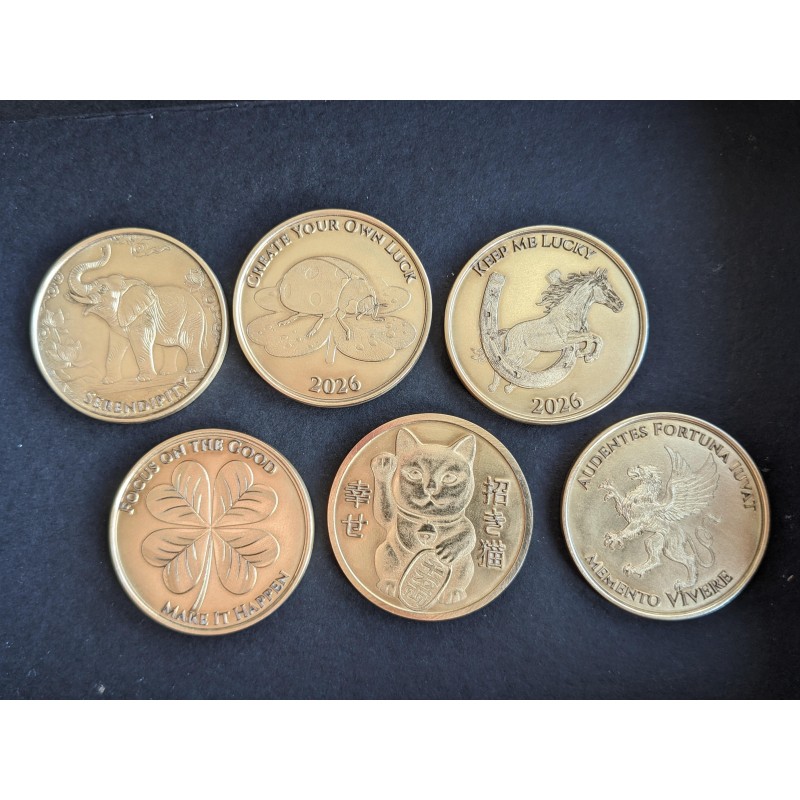


Choose a design for each side of the coin and customise any text in the design to make your unique lucky coin.
Your chosen text will be incorporated into the design before I emboss it onto a solid brass coin (40mm in diameter and approximately 3.5mm thick).
Any text you seen in the designs can be customised. Tell me what text to incorporate into your Lucky Coin in the product customisation field. For example:
- Ladybird top "Bringing Luck Since" bottom "1976"
- Griffin top "Live in the Moment" bottom "Choose Life"
Text can also be removed.
The text size will be adjusted to fit the number of words.
Product customisation
Don't forget to save your customization to be able to add to cartI make these coins from solid brass, the coin is 40mm across and approximately 3.5mm thick. Each coin is made to order after adjusting my design to incorporate your choice of personal text.
Coin comes in clear case with small display stand and packaged in a neat little card box.
"Lucky coins" have served as symbols of protection, wealth, and destiny for thousands of years. From ancient talismans used to bribe the ferryman of the underworld to modern-day pennies found on the sidewalk, these coins represent the human desire to influence fate through small, tangible objects.
Psychologists suggest that carrying a lucky coin can actually improve performance. By reducing anxiety and increasing confidence, a "lucky" object can create a self-fulfilling prophecy—you feel luckier, so you act more boldly, which often leads to better outcomes.
Each of the four leaves is assigned a specific meaning:
- The Four Virtues: Faith, Hope, Love, Luck
- Four Seasons: Spring, Summer, Autumn, Winter
- Four Elements: Earth, Air, Fire, Water
- Four Cardinal Directions: North, South, East, West
The belief that a four-leaf clover is lucky is a blend of extreme botanical rarity and ancient mystical traditions. While a standard shamrock (three leaves) is common, a four-leaf clover is a genetic mutation that occurs in approximately 1 out of every 5,000 to 10,000 clovers.
While the White Elephant is a specific royal and religious icon, the general symbol of the Elephant is considered lucky for broader reasons involving its physical nature and its role in ancient mythology.
In many cultures, an elephant isn't just an animal; it's a "living charm" for stability, wisdom, and the removal of life's hurdles.
Trunk Up is said to promote Victory & Prosperity, attracting good fortune, success, and "showering" blessings on the home.
The ladybird (or ladybug) is one of the few insects almost universally loved and considered lucky. Like many of the other symbols, its "luck" is a mix of practical agricultural help and deep religious folklore.
A common belief is that the number of spots on a ladybird's back tells you something about your future luck.
A common Japanese figurine believed to bring good luck to the owner A raised paw invites good fortune.
The Maneki-neko (literally "Beckoning Cat") is perhaps Japan’s most famous lucky charm. While often mistaken for a "waving" cat in the West, the paw is actually held palm-down and moved in a beckoning motion, which is the traditional Japanese gesture for calling someone over.
Cat is holding a Koban (gold coin). Japanese writing translates to "Happiness" and "Beckoning Cat".
In mythology and folklore, the Griffin (or Gryphon) is seen as a symbol of protection, guardianship, and divine justice. It's a symbol to protect your home, succeed in business, or ensure justice in your life, the Griffin is considered the most powerful "lucky" protector you can find.
The horseshoe is one of the world’s most famous "all-purpose" charms, used for everything from protecting a new home to ensuring a happy marriage. Its luck comes from a fascinating mix of metalwork, religious legend, and celestial shapes.
Fun Fact: For the maximum "luck factor," many traditions state that the horseshoe must be found by chance rather than bought, and it is even luckier if it was once worn by a grey mare.
Seven is considered a "perfect" number in many cultures; seven days of the week, seven colours in a rainbow, seven seas.
The scarab beetle is one of the oldest and most powerful lucky charms in human history, originating in Ancient Egypt. To the Egyptians, the scarab wasn't just a bug; it was a biological representation of the sun and the cycle of life itself.
Cherry blossom is about serendipity, new beginnings, and the beauty of the present moment.
The "luck" of the cherry blossom is deeply tied to the Japanese concept of mono no aware, or "the pathos of things." Because the blossoms only last for about a week or two before falling, they represent; Living in the Moment and Graceful Renewal.
Choose a design for each side of the coin and customise any text in the design to make your unique lucky coin.
Your chosen text will be incorporated into the design before I emboss it onto a solid brass coin (40mm in diameter and approximately 3.5mm thick).
Any text you seen in the designs can be customised. Tell me what text to incorporate into your Lucky Coin in the product customisation field. For example:
- Ladybird top "Bringing Luck Since" bottom "1976"
- Griffin top "Live in the Moment" bottom "Choose Life"
Text can also be removed.
The text size will be adjusted to fit the number of words.